Post

Visualizzazione dei post con l'etichetta genetic

Y chromosome analysis moves Adam closer to Eve. Interview with Riccardo Berutti

Immagine
“Mitochondrial DNA and Human Evolution” was the title of a scientific article that appeared in the January 1, 1987 issue of Nature, authored by Rebecca Cann, Mark Stoneking, and Allan C. Wilson. These three scientists announced that all modern human beings can trace their ancestry back to a single woman (the so-called "Mitochondrial Eve" ), who lived about 190.000 to 200.000 years ago in Africa. Scientists estimated that "Y-Chromosomal Adam" , the most recent common ancestor of men, lived much more recently, between 50,000 to 115,000 years ago. The disparity between our most recent common ancestors (MRCA) might have resulted from limitations in gene sequencing: up until about five years ago, researchers could sequence only a few regions of the genome. According to a couple of papers published on Science magazine the 2 August 2013 there is a good chance that Adam and Eve may have existed about the same time, evolutionarily speaking. Using the complete strand o...

L'alba dei transistor viventi.

Immagine
A Stanford fanno sul serio. Uno studio pubblicato su Science il 28 Marzo 2013 contiene la descrizione del transcriptor : il primo transistor biologico, nel quale DNA e di RNA prendono il posto dei semiconduttori. Analogamente a quanto accade in elettronica, dove il transistor controlla il flusso di elettroni in un circuito e lo può all'occorrenza amplificare, così il transcriptor, in questo caso, controlla il flusso dell'RNA polimerasi, nel suo viaggio lungo i filamenti del DNA. E può a sua volta fare da amplificatore genetico: una variazione molto piccola nell'espressione dell'integrasi può generre una variazione significativa nell'espressione di eventuali altri due geni.   I bioingegneri di Stanford con il transcriptor hanno realizzato porte logiche dotate di una propria "Boolean Integrase Logic" (immagine sotto).  Non siamo ancora al "computer biologio", certo, ma se pensiamo alla rivoluzione che i transistor sono stati in grado di gen...

The Fate of Ramesses III (video interview with Albert Zink)

Immagine
The fate of Ramesses III , second pharaoh of the 20th dynasty that reigned from 1186 BC to 1155 BC , has long been a debated topic. The discovery of papyrus documents shows that members of his harem, in 1155 BC , made an attempt on his life. The conspiracy was led by Tiye , one of his two known wives, and her son Pentawere , who would inherit the throne. Today a team of researchers, led by paleopathologist Albert Zink (European Academy of Bolzano/Bozen in Italy), revealed new anthropological and forensic analyses on two mummies: Ramesses III and unknown man E (suspected son of the pharaoh). The CT scans of Ramesses III revealed a wide and deep wound in the throat (fifth to seventh cervical vertebra) of the mummy: the trachea was clearly cut, and its proximal and distal ends were retracted and separated by about 30 mm. A small, focal cortical interruption at the vertebral body was visible (seventh cervical vertebra). Inside the wound the researchers found a Horus eye amulet , ...

Longevity: to Melis Family from Perdasdefogu (Sardinia Island) the new world record for the highest combined age for nine living siblings (21 August 2012)

Immagine
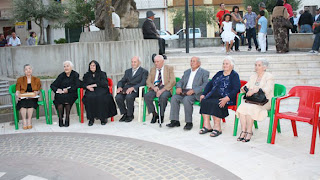
A family from Perdasdefogu (Sardinia Island) have set a new world record for longevity , taking the title for the highest combined age for nine living siblings .The three brothers and six sisters from the Melis family had a collective age of 818 years and 205 days verified by Guinness World Records on June 1st, after seven years of careful investigation, by the Guinness World Records researchers. Demographic analysis in the Mediterranean island of Sardinia revealed an extreme longevity in a mountain inner area where the proportion of oldest subjects among male population has one of the highest validated value worldwide. Many studies on longevity in the population of Sardinia (NIH, CNR, etc) suggest that biological and genetic factors, behavioral factors including life style, food quality, demographic behavior, family support and community characteristics may play an important role. Sardinia, which was first settled around 6,000 B.C., is home to one of the world...