Post

Visualizzazione dei post con l'etichetta network

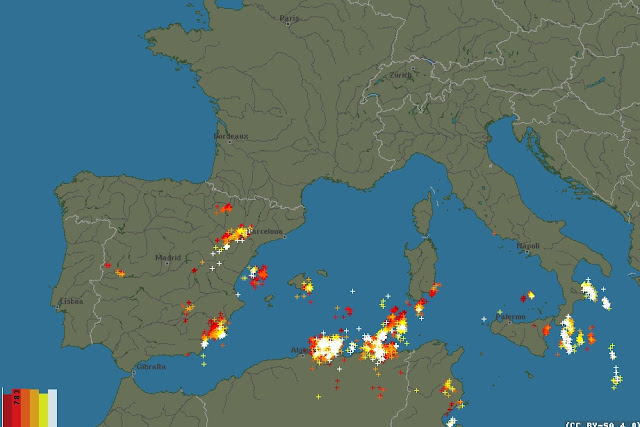
Blitzortung: mappa dei fulmini in tempo reale: A community collaborative real-time lightning location network

Immagine
blitzortung.org "A community collaborative real-time lightning location network " è una mappa dei fulmini in tempo (quasi, perché è necessaria qualche verifica) reale. Questo è il Link per l'Europa. E se volete fornire le vostre segnalazioni è sufficiente usare un rilevatore di fulmini .

Fritjof Capra: from The Tao of Physics to the Systems View of Life. Exclusive interview.

Immagine
Portrait of Fritjof Capra [ Zenobia Barlow ] Fritjof Capra goes beyond The Tao of Physics ( published in 1975 and translated into 17 languages) with the book The Systems View of Life. A Unifying Vision (written with Pier Luigi Luisi). This volume integrates the ideas, models, and theories underlying the systems view of life into a single coherent framework. Fritjof Capra gave us an exclusive interview about his view of the universe. As a 18-year-old student you was seduced by Werner Heisenberg's most popular book: Physics and Philosophy. Why? «In this book, Heisenberg vividly described the conceptual and emotional struggles of the quantum physicists whose explorations of the atomic and subatomic world brought them into contact with a strange and unexpected reality. In their attempts to grasp this new reality, they became painfully aware that their basic concepts, their language, and their whole way of thinking were inadequate to describe atomic phenomena. Quantum phy...

Rainforest: regole e assiomi, innovazione e creatività

Immagine
Prima di iniziare a leggere Rainforest ho analizzato i punti sui quali si basa il ragionamento sull'innovazione di Greg Horowitt e Victor Hwang . Si tratta di 7 regole e 14 assiomi. Le 7 regole sono queste: rompere gli schemi, sognare, aprirsi al dialogo, saper ascoltare, aver fiducia, fidarsi, sperimentare e testare, superare l'egoismo, reagire agli errori, non fare tutto solo per il tornaconto. Eccole di seguito: 1) "Thou shalt break rules and dream"; 2) "Thou shalt open doors and listen"; 3) "Thou shalt trust and be trusted"; 4) "Thou shalt experiment and iterate together"; 5) "Thou shalt seek fairness, not advantage"; 6) "Thou shalt err, fail, and persist"; 7) "Thou shalt pay it forward". Ed ecco i 14 “Rainforest Axioms ”: While plants are harvested most efficiently on farms, weeds sprout best in Rainforest Rainforests are built from the bottom up, where irrational behavior reigns What...
La "saggezza delle masse" per studiare le reti di geni. Ce la spiegano Alberto De La Fuente, Vincenzo De Leo, Andrea Pinna e Nicola Soranzo.

Immagine
Il valore della conoscenza collettiva di una comunità umana è superiore alla somma delle conoscenze individuali. Sulla base di questo concetto un gruppo di ricerca internazionale ha sviluppato un approccio inedito per affrontare una delle sfide più impegnative nel campo della biologia molecolare e computazionale: scoprire e modellare reti di geni. Approccio reso possibile dall'evoluzione tecnologica ma anche dall'affinamento concettuale. Lo studio, pubblicato su Nature Methods il 15 Luglio 2012 con il titolo "Wisdom of crowds for robust gene network inference" , ha portato a ottenere una rete genica migliorata per l'organismo Escherichia coli e una rete genica completamente nuova per il batterio patogenico  Staphylococcus aureus Per cercare di capire il valore di questo studio ho interpellato quattro degli autori: Alberto de la Fuente (CRS4), Vincenzo De Leo (LinkaLab, CRS4), Andrea Pinna (CRS4), Nicola Soranzo (CRS4). Alberto De La Fuente, qual...

Wisdom of crowds to infer gene networks, published on Nature Methods, 15 July 2012.

Immagine
This publication shows for the first time a community-wide effort to infer gene networks. The work resulted in an improved gene network from the model organism Escherichia coli and a completely novel gene network from the pathogenic bacterium Staphylococcus aureus . I asked Alberto de la Fuente (CRS4, Dream5 consortium) to explain objectives and methods of this research. What is the main idea of this research? "The idea is that we addressed network inference as a community, as a 'crowd'. Many groups from all over the world inferred networks from the same data. It is shown in this paper that creating a 'community consensus' network from all the different inferred networks is more reliable than any of the individual networks. Hence, the crowd is 'wiser' than any of the individuals in it". What is the role played by you and your collegues of CRS4 into the Dream5 consortium (Andrea Pinna, Vincenzo De Leo and Nicola Soranzo)? "We were one of...