Post

Visualizzazione dei post con l'etichetta live picture production

Augusto Bissiri, inventore sardo del secolo scorso: una lunga e incredibile storia

Immagine
Augusto Bissiri (Cagliari 10 settembre 1879 – Los Angeles, 25 febbraio 1968) il 14 Luglio 1925 brevetta un sistema elettromeccanico di visione denominato Live Picture Production (A. Bissiri, US Patent July 14, 1925). Un dispositivo in grado di migliorare il disco di Nipkow  e di entrare quindi nella lunga storia di innovazioni che ha portato all'invenzione della televisione. Ho raccontato questa vicenda in un articolo «E Philo inventò la tv» pubblicato il 17 Settembre 2007 sulla pagina della cultura del quotidiano L'Unione Sarda. La storia di Augusto Bissiri ha dell'incredibile: frequenta Ingegneria. a Roma, per un anno, poi si sposta a Giurisprudenza e si laurea nel 1903. Dopo due anni parte per gli Stati Uniti dove deposita alcuni brevetti, tra i quali: Sheet music turner (1906) Transmission of pictures (1929) Dial cleaner for automatic telephones (1930) Cigarette Extinguisher (1933) Un articolo pubblicato sul quotidiano L'Unione Sarda il 22 Maggio 190...
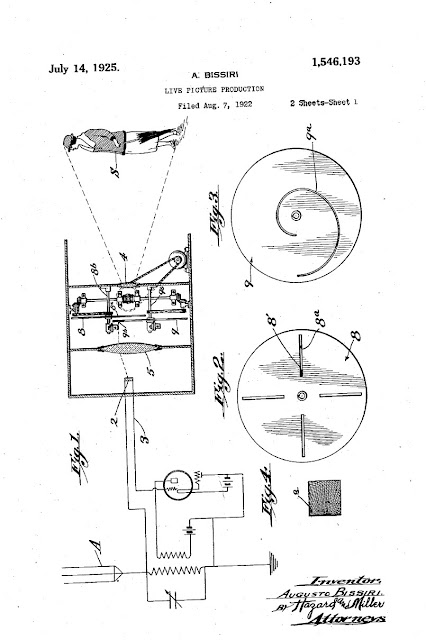
Live Picture Production (A. Bissiri, US Patent July 14, 1925)

Immagine
July 14, 1925. Application led August 7, 1922. Serial No. 580,119. To all whom it may concern. Be it known that I, Augusto Bissiri, a citizen of the United States, residing at Los Angeles, in the county of Los Angeles and State of California, have invented new and useful Improvements in Live-Picture Production, of which the following is a specification. This invention relates to electrical apparatus and has for its object to prove a method and apparatus for the projection o live or motion pictures. An object of the invention is to provide an apparatus and method whereby picture reproductions of animate and inanimate scenes and objects can be broadcasted by so called Wireless telegraph apparatus and received by the same. A broad object of the invention is to provide means whereby a transmitting electrical current is controlled and varied by the degree of light which is imposed upon an element of -the transmitting apparatus, and to provide means for receiving a transmitted Wave and whic...